

The optional High Availability extension is part of the IGEL UMS. It is designed to address the needs of large environments in which new settings need to be rolled out at once, or in which the fail-safe rollout of new settings is mission-critical for the organization concerned.
Distributed UMS vs. UMS High Availability (HA)
If you want to install the UMS with multiple servers, IGEL recommends to use the Distributed UMS feature:
-
for new installations
-
for existing single-instance installations. For more details, see IGEL UMS Installation.
If you have an existing fully functional HA installation, you can leave everything as it is. Note, however, that no new features will be added for the UMS HA.
If you want to migrate, see How to Migrate a UMS High Availability Installation to a Distributed UMS.
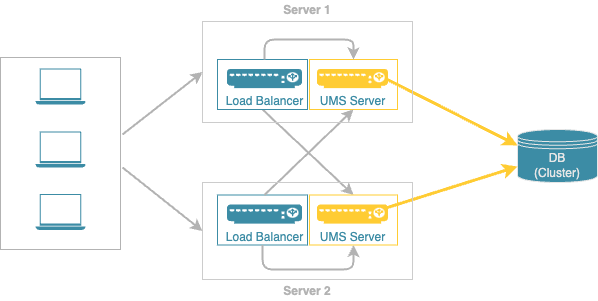
The technical implementation is based on a network of several UMS Servers.
An upstream UMS Load Balancer takes over the load distribution and thus ensures that each device can receive new settings at any time – even at the start of a working day when a large number of devices log in to the UMS Server simultaneously and request new configuration profiles or firmware updates. To ensure maximum process reliability and high availability, IGEL also recommends that the UMS Load Balancer and the database have a redundant design.
Example:
See also IGEL UMS HA Configuration Options.
See also the collection of articles High Availability UMS.