
Die Kommandozeilenschnittstelle (CLI) des Universal Management Suite (UMS) Administrators ermöglicht es Ihnen, den IGEL UMS Administrator über ein Terminal zu steuern und Aktionen des UMS Administrators per Skript zu automatisieren. Zu diesen Aktionen gehören unter anderem das Erstellen und Bearbeiten von Datenbankverbindungen für den UMS Server, das Sichern und Wiederherstellen der eingebetteten Datenbank, das Konfigurieren von Kommunikationsports und Sicherheitseinstellungen, das Verwalten der UMS-ID, das Konfigurieren des Superusers sowie das Neustarten des UMS Servers.
Da diese Funktion eine vollständige Steuerung ohne grafische Desktop-Umgebung ermöglicht, kann die CLI-Anwendung auch auf Linux-Systemen ohne grafische Oberfläche (Headless-Systeme) ausgeführt werden.
Ab UMS 12.08.100 steht zusätzlich das Skript umsadmin-cli.sh zur Verfügung, das unter Linux dieselbe Funktionalität wie umsadmin-cli.bin bietet, jedoch ohne die QT-Abhängigkeit. Es kann verwendet werden, wenn QT-Abhängigkeiten nicht verfügbar oder nicht erwünscht sind, beispielsweise auf Headless-Linux-Systemen oder in Containern.
Wenn die QT-Abhängigkeit installiert ist, können Sie frei zwischen den Skripten .sh und .bin wählen.
Grundlegende Verwendung
Wie die grafische Anwendung UMS Administrator benötigt auch die CLI erhöhte Berechtigungen.
→ Windows: Öffnen Sie eine Eingabeaufforderung (cmd.exe) als Administrator.
→ Linux: Wechseln Sie zu root oder verwenden Sie sudo
Sie können den Hauptbefehl umsadmin-cli aus jedem Verzeichnis heraus ausführen, da der Befehl über den PATH verfügbar gemacht wird.
→ Um die globalen Optionen und die primären Unterbefehle anzuzeigen, geben Sie Folgendes ein: umsadmin-cli
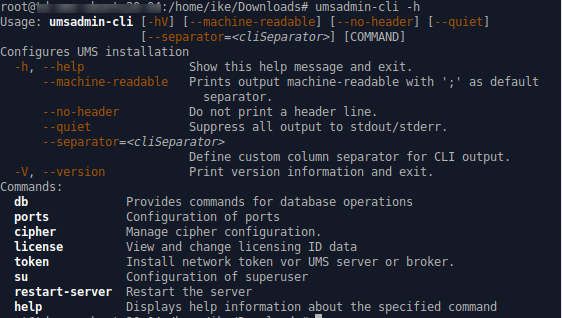
→ Um alle verfügbaren Optionen für einen bestimmten Unterbefehl anzuzeigen, geben Sie umsadmin-cli gefolgt vom Unterbefehl ein, z. B.: umsadmin-cli db create
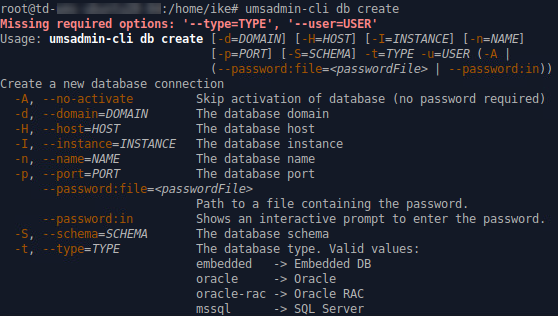
Bestimmte Unterbefehle besitzen keine Optionen und werden sofort ausgeführt. Weitere Informationen finden Sie in der Befehlsreferenz.
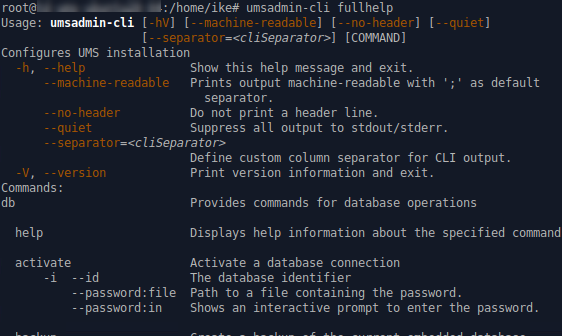
→ Um die vollständige Online-Hilfe mit allen Befehlen anzuzeigen, geben Sie Folgendes ein: umsadmin-cli fullhelp
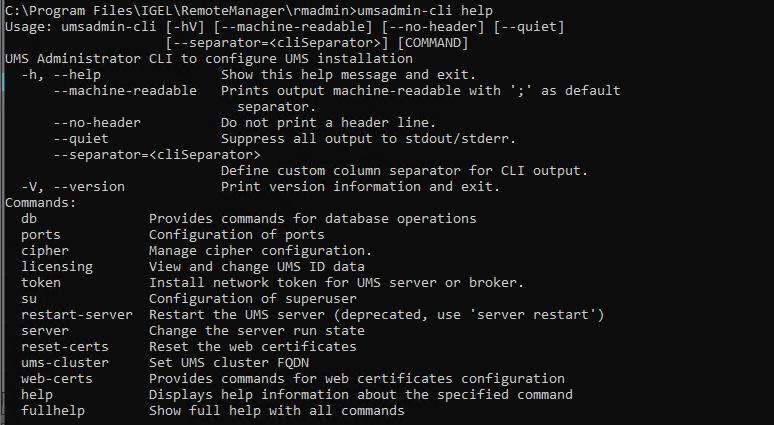
→ Um die Liste der verfügbaren Befehle anzuzeigen, geben Sie Folgendes ein: umsadmin-cli help
→ Um Hilfeinformationen zu einem beliebigen Befehl anzuzeigen, verwenden Sie help als Unterbefehl. Beispiel: umsadmin-cli web-certs help
Globale Optionen
Wenn Sie die CLI des UMS Administrators in einem Skript verwenden möchten, können Sie die Ausgabe auf stdout/stderr entsprechend Ihren Anforderungen konfigurieren. Dadurch lässt sich die Ausgabe von umsadmin-cli einfach weiterverarbeiten und relevante Informationen können extrahiert werden.
Nachfolgend finden Sie die verfügbaren Optionen.
--machine-readable
Gibt die Ausgabe maschinenlesbar aus. Standardmäßig wird das Semikolon (;) als Trennzeichen verwendet.
Beispiel:
root@machine:/home/locadmin# umsadmin-cli --machine-readable db list
ACTIVE;DATABASE;HOST;USER;DB-TYPE;ID
true;rmdb;localhost;root;Embedded DB;1
--no-header
Es wird keine Kopfzeile ausgegeben. (Nicht alle Befehle erzeugen eine Kopfzeile.)
Beispiel:
root@machine:/home/locadmin# umsadmin-cli --machine-readable --no-header db list
true;rmdb;localhost;root;Embedded DB;1
--quiet
Unterdrückt für bestimmte Befehle sämtliche Ausgaben auf stdout/stderr, insbesondere für Befehle, deren Ausführung längere Zeit dauern kann. Dazu gehören beispielsweise: db backup, db restore, db copy, and server-restart.
Beispiel:
root@machine:/home/locadmin# umsadmin-cli --quiet db backup -o /tmp/mybackup02.pbak --full
root@machine:/home/locadmin#
Es ist weiterhin möglich, sämtliche Ausgaben mithilfe von Betriebssystemfunktionen auf ein Nullgerät umzuleiten. Unter Linux können Standardausgabe und Fehlerausgabe beispielsweise wie folgt umgeleitet werden:
command … >/dev/null 2>&1
--separator
Definiert ein benutzerdefiniertes Spaltentrennzeichen für die Ausgabe auf stdout/stderr.
Beispiel:
root@machine:/home/locadmin# umsadmin-cli --machine-readable --no-header --separator "||" db list
true||rmdb||localhost||root||Embedded DB||1
Einige Trennzeichen, beispielsweise das Pipe-Symbol (|), müssen in Anführungszeichen gesetzt werden, da sie im Terminal eine spezielle Bedeutung haben.
Exit-Codes
|
Exit-Code |
Bedeutung |
|---|---|
|
0 |
Erfolgreiche Ausführung |
|
1 |
Interner Fehler. Eine Fehlernummer wird auf stderr ausgegeben; Details finden Sie unter Fehlernummern. |
|
2 |
Falsche Verwendung der CLI oder ungültige Argumente |
Befehlsreferenz
Allgemeine Verwendung von Passwortoptionen
Einige Befehle benötigen ein Passwort. Die Eingabe eines Passworts im Klartext auf der Kommandozeile ist unsicher und daher nicht möglich. Stattdessen muss eine der folgenden Passwortoptionen verwendet werden:
--password:in für die interaktive Eingabe des Passworts (gegebenenfalls mit Bestätigung)
--password:file <DATEI> zur Angabe einer Datei, die das Passwort enthält
Eine Passwortdatei muss das Passwort in der ersten Zeile enthalten. Das Passwort darf nicht ausschließlich aus Leerzeichen bestehen. Zusätzliche Zeilen mit Inhalt sind zulässig, werden jedoch nicht ausgewertet.
Neustart des UMS Servers erforderlich
Die meisten Befehle in den Abschnitten Ports, Cipher, Zertifikate zurücksetzen und Superuser ändern die Konfiguration der UMS. Damit die neuen Einstellungen wirksam werden, ist ein Neustart des UMS Servers erforderlich. Dies kann auf zwei Arten erfolgen:
-
Verwenden Sie die entsprechende Funktion des Betriebssystems (z. B.
systemctlunter Linux) -
Verwenden Sie den folgenden Befehl:
umsadmin-cli server restart
Datenbank
Ports
Cipher
Web-Zertifikate verwalten
Accept Expired Client Certificates
Superuser
UMS ID
UMS License
Network Token
UMS Cluster
Server
Encrypting and Encoding
Error Numbers
The error numbers are printed in the following format:
<E-NNNN>: <HUMAN READABLE MESSAGE>
Some error descriptions in the following table contain the phrase „[param]“. These will be replaced during runtime with details for the relevant error, e.g. the problematic path for E-1030.
|
Error number |
Error description |
|---|---|
|
1000 |
Unable to connect to database. UMS server may be down. |
|
1001 |
Cannot get database configurations. |
|
1002 |
Cannot create database. |
|
1003 |
Cannot activate database. [param] |
|
1004 |
Internal error while activating database. |
|
1005 |
Database already exists in this configuration. |
|
1006 |
Database type is unknown. |
|
1007 |
Database is already activated. |
|
1008 |
Cannot edit database configurations. |
|
1009 |
Internal error while optimizing database. |
|
1010 |
The active data source type is not Embedded or Derby and does not support optimization. |
|
1011 |
Test of the active data source failed. |
|
1012 |
No database is activated. |
|
1013 |
Cannot deactivate database. |
|
1014 |
No database is active or the active database is not of type 'Embedded' or 'Derby'. |
|
1020 |
Database could not be deleted. |
|
1030 |
The specified directory for the backup does not exist: [param] |
|
1031 |
Internal error while attempting database backup. |
|
1040 |
The specified backup file was not found. |
|
1041 |
The specified backup file has an invalid file type. |
|
1042 |
Unable to read the specified backup file. |
|
1043 |
Internal error while activating data source after restore. |
|
1044 |
Internal error while attempting to restore database. |
|
1045 |
The active data source is not embedded or there is no active data source. |
|
1051 |
Authentication error or internal error when an attempt was made to copy the database |
|
1052 |
Error Accessing credentials of source database |
|
1090 |
A name is required for non-embedded database types. |
|
1091 |
Activation failed, incorrect password provided. |
|
1092 |
Backup failed, the specified file already exists. |
|
1093 |
Port number is required for non-Embedded database. |
|
1094 |
A data source of the Embedded type cannot be edited. |
|
1095 |
No such data source with this ID. |
|
1100 |
The name 'rmdb' is reserved for the Embedded database. |
|
2000 |
Internal error while reading port configuration. |
|
2001 |
Internal error while setting port configuration. |
|
2002 |
Internal error while restarting UMS server. |
|
2003 |
Invalid port number provided. |
|
2004 |
Port number [param] already configured. |
|
3000 |
Internal error while reading cipher data. |
|
3001 |
Internal error while changing cipher configuration. |
|
3002 |
Invalid ciphers provided: [param] |
|
4000 |
Resetting web certificates requires '--yes' option for confirmation. |
|
4001 |
Internal error while resetting web certificates. |
|
5000 |
Internal error while reading superuser credentials. |
|
5001 |
Internal error while writing superuser credentials. |
|
5002 |
No username was provided for new credentials. |
|
5003 |
Unable to set superuser credentials. There is no active data source. |
|
6000 |
Unable to create a new UMS ID. |
|
6001 |
The specified file for the license key backup already exists. |
|
6002 |
No internal license keystore found. |
|
6003 |
Internal error while creating license key backup. |
|
6004 |
Internal error while restoring license key backup. |
|
6005 |
The specified file for the license key backup does not exist. |
|
6006 |
The specified password for the license key backup is incorrect. |
|
6007 |
The specified path for the license key backup does not exist: [param] |
|
7000 |
Token file was not found. |
|
7001 |
Setup type not defined, token not installed. |
|
7501 |
Unable to set UMS cluster FQDN. |
|
7502 |
Unable to show UMS cluster FQDN. |
|
7503 |
Unable to delete the cluster FQDN. |
|
8000 |
Internal error while restarting the UMS server. |
|
8001 |
Internal error while starting the UMS server. |
|
8002 |
Internal error while stopping the UMS server. |
|
8003 |
Internal error while ending the update mode of the UMS Server. |
|
8004 |
Internal error while setting the distributed mode of the UMS installation. |
|
8005 |
Either --enable or --disable must be provided in the options. |
|
8006 |
Distributed UMS not recommended for Derby Embedded Database. |
|
9000 |
An error with the password file occurred: [param] |
|
9001 |
The provided passwords did not match. Aborted. |
|
9002 |
The provided password exceeds the maximum character limit ([param]) or contains only whitespace. |
|
9700 |
File [param] doesn't exist! |
|
9701 |
Keystore contains no certificate entries! |
|
9702 |
Keystore password is invalid! |
|
9703 |
Keystore couldn't be read! |
|
9704 |
Could not import certificate chain! |
|
9705 |
Internal error while importing certificate chain! |
|
9706 |
No SHA1 fingerprint specified! |
|
9707 |
Could not delete certificate(s) with SHA1 fingerprint [param]! |
|
9708 |
Certificate must not be deleted because it is currently in use! |
|
9709 |
Root certificate creation failed! |
|
9710 |
Certificate could not be created! Private key of CA certificate is not known. |
|
9711 |
Certificate could not be created! CA certificate is not valid. |
|
9712 |
Could not find CA certificate with specified fingerprint. |
|
9713 |
Certificate could not be created! CA certificate does not meet the requirements. |
|
9714 |
Certificate could not be created! Requirements for CA certificate creation are not met. |
|
9715 |
Creation of signed certificate failed! |
|
9716 |
Certificate could not be created! Certificate name too long (only 200 characters are allowed)! |
|
9717 |
Could not find certificate with specified fingerprint! |
|
9718 |
Certificate could not be renewed! Certificate has no CA parent. |
|
9719 |
Certificate file [param] doesn't exist! |
|
9720 |
Certificate is invalid! |
|
9721 |
Import of certificate failed! No CA certificate. |
|
9722 |
Import of certificate failed! |
|
9723 |
Import of certificate failed! Certificate is not valid. |
|
9724 |
Import failed! Certificate doesn't contain any subject alternative names. |
|
9725 |
Import of private key failed! File [param] doesn't exist. |
|
9726 |
Import of private key failed! Private key is encrypted. Decrypt it before importing it. |
|
9727 |
Import of private key failed! |
|
9728 |
Certificate already has private key! |
|
9729 |
Import of private key failed! Private key does not match the specified certificate. |
|
9730 |
Export of certificate failed! Directory [param] doesn't exist. |
|
9731 |
Export of certificate failed! |
|
9732 |
Export of certificate chain failed! Directory [param] doesn't exist. |
|
9733 |
Certificate must not be a root or CA certificate! |
|
9734 |
Export of certificate chain failed! |
|
9735 |
Password must be at least 6 characters long! |
|
9736 |
Assignment of certificate failed! |
|
9737 |
Private key is not known! |
|
9738 |
Could not read certificate info! |
|
9739 |
Import failed! Certificate with same fingerprint already exists. |
|
9740 |
Import failed! No valid root certificate. |
|
9741 |
Import failed! Verification of signature failed. |
|
9742 |
Import failed! No valid CA certificate available. |
|
9743 |
Could not read assigned server info! |
|
9744 |
Could not find certificate with specified fingerprint or no server is assigned to certificate! |
|
9745 |
Common name is invalid! Only A-Z, a-z, 0-9, - and . are allowed. |
|
9800 |
Registration of UMS license failed! License file doesn't exist. |
|
9801 |
Registration of UMS license failed! Invalid path specification. |
|
9802 |
Registration of UMS license failed! License file is invalid. |
|
9803 |
Registration of UMS license failed! License file already exists. |
|
9804 |
Registration of UMS license failed! UMS ID doesn't match. |
|
9805 |
Registration of UMS license failed! Invalid signature. |
|
9806 |
Registration of UMS license failed! License expired. |
|
9807 |
Registration of UMS license failed! Error during processing. |
|
9808 |
Registration of UMS license failed! Further details are not available. |
|
9809 |
Registration of UMS license failed! Error processing Commandline!. |
|
9830 |
The license status could not be determined! Further details are not available. |
|
9831 |
The license status could not be determined! There is no data available to determine the license status. |
|
9832 |
The license status could not be retrieved in JSON Format! The data could not be processed. |
|
9850 |
Deletion of registered licenses failed! Database Error. |
|
9859 |
Deletion of registered licenses failed! Further details are not available. |